
Windows 11’s August 2026 Patch Tuesday update is available for everyone and is yet another massive release, patching up to 421 security issues. It’s not as extensive as the July 2026 Patch, which addressed a record 570 vulnerabilities, but you must not delay it by more than 3 days, according to Microsoft’s advisory.
On the second Tuesday of every month, Microsoft rolls out Patch Tuesday updates for all supported products, and the August 2026 update is part of that cadence. However, lately you might have noticed that these updates are getting bigger and bigger. Microsoft argues that large Patch Tuesday updates will become common due to rising AI threats.
According to the company, the Windows 11 August 2026 Update fixed at least 37 remote code execution bugs and five elevation-of-privilege bugs.
Microsoft has officially fixed 421 bugs in August’s update, and it includes the patches rolled out earlier this month for Entra, Office, Teams, and other products. If you only care about fixes rolling out on Tuesday, the number comes down to 400 fixes, which is again huge.
| Month | Flaws fixed in 2025 | Flaws fixed in 2026 | Year-over-year change |
|---|---|---|---|
| January | 159 | 114 | -28.3% |
| February | 55 | 58 | +5.5% |
| March | 57 | 79 | +38.6% |
| April | 134 | 167 | +24.6% |
| May | 72 | 120 | +66.7% |
| June | 66 | 200 | +203% |
| July | 137 | 570 | +316.1% |
| August | 107 | 400 | +273.8% |
| January–August total | 787 | 1,708 | +117.0% |
Note: This data does not include fixes rolled out in August outside the Patch Tuesday cycle, which is why we have 400 flaws rather than 421. Sourced from Microsoft’s security portal.
How to verify if your Windows 11 installation received the 400+ security fixes
If you use Teams, Office, Edge, and other products, the total number of fixes rises to 421, as they were rolled out earlier this month. In either case, Edge, Teams, and other Microsoft products update automatically, so you’re sorted. But if you’re on Windows 11, make sure you haven’t accidentally paused updates and that you’re using the recommended version.
As of August 12, Microsoft recommends running Windows 11 Build 26200.9168 if you are on 25H2, and 26100.9168 if you are on 24H2. You can verify it by opening Settings > System > About and looking closely at the build number.
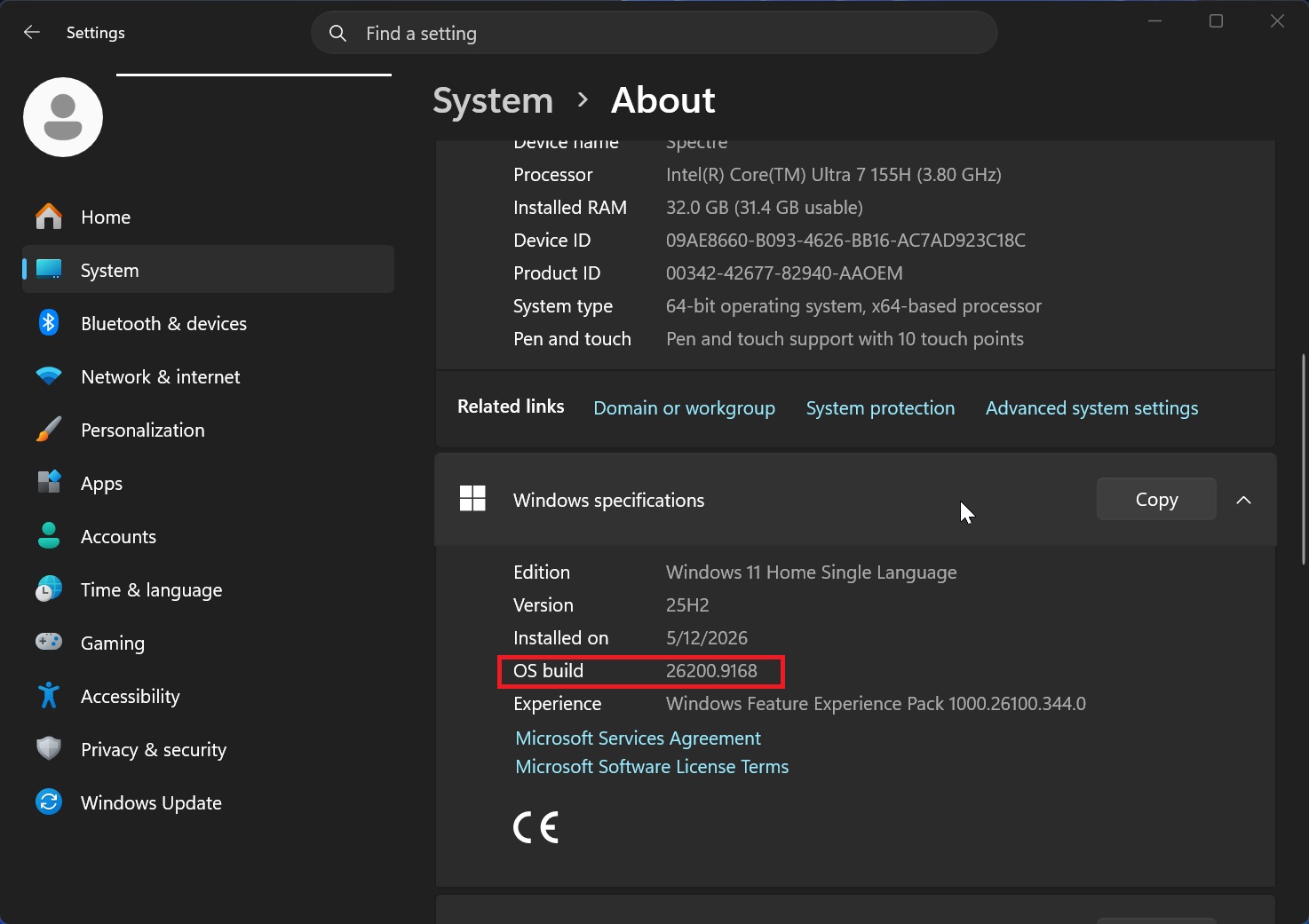
If it matches what I have, or is higher in the 26200.xxxx or 26100.xxxx series, then you’re good to go.
In all other cases, go to Windows Update, make sure you’ve not turned off updates, and check for updates. The August 2026 Update shows up as KB5121003, and you can download it right away. Also, I noticed that the update could take up to two reboots to finish applying, and it’s due to Secure Boot.
How big is the August 2026 Update for Windows 11?
I’ve been going through Microsoft’s official security documentation, and the list of fixes is huge, as you can already see in the table above, but there are certain fixes that require more of your attention.
Microsoft is patching major security bugs across Windows, including the kernel, Remote Desktop, DNS, DHCP, SMB, Windows Defender Firewall, Desktop Window Manager, Windows Installer, Kerberos, LDAP, and the networking stack.
The company has also fixed bugs rated as “critical,” including a remote code execution vulnerability in the Remote Desktop Client, along with critical RCE flaws in Windows DNS Server, DHCP Server, Windows Deployment Services, Routing and Remote Access Service (RRAS), Secure Socket Tunneling Protocol (SSTP), and the Reliable Multicast Transport Driver.
Microsoft fixed multiple elevation-of-privilege vulnerabilities in the Windows kernel and Desktop Window Manager, two remote code execution flaws affecting the SMBv3 Server, several Remote Desktop Services bugs, and additional RCE vulnerabilities in Windows LDAP and other core components.
Microsoft wants you to stop pausing Windows updates, and they are not wrong
Windows is not the most secure operating system, and it doesn’t matter how much Microsoft wants to sell you its narrative. It isn’t, and it can’t be anytime soon, as Windows is home to hundreds of legacy components, and one or another will have a bug at some point, especially due to AI-accelerated debugging.
Microsoft also previously confirmed that the rise in the number of bugs is not just limited to Windows, as AI is affecting the rest of the industry as well.
“This is on par with the rest of the industry, with AI speeding up how quickly software vulnerabilities are found and exploited, often from weeks to hours, including zero days,” the company said.
“There’s been a significant increase in security updates across the industry,” says Jeremy, who is a director at Microsoft 365. You can watch his full briefing below:
Microsoft is also using its AI model, which the company says is better than Claude’s Mythos, to identify bugs and address them in Windows or other products. That also explains why we are seeing hundreds of bug fixes in a single release. Microsoft is able to identify bugs faster, and if it doesn’t use AI, attackers would use it to exploit the bug.
Previously, Microsoft warned against delaying these monthly updates, and it shared the following note, which is applicable to the August 2026 Patch Tuesday:
If you’re not delivering critical quality updates with security fixes until a couple of weeks after they’ve been issued, that’s ample time for attackers using AI to find and exploit known security gaps. To address this, we’ve updated our recommendations for deploying Windows updates to less than three days as the deferral period for quality updates, setting deadlines for those updates to zero or one day, and the update grace period to a maximum of two days.
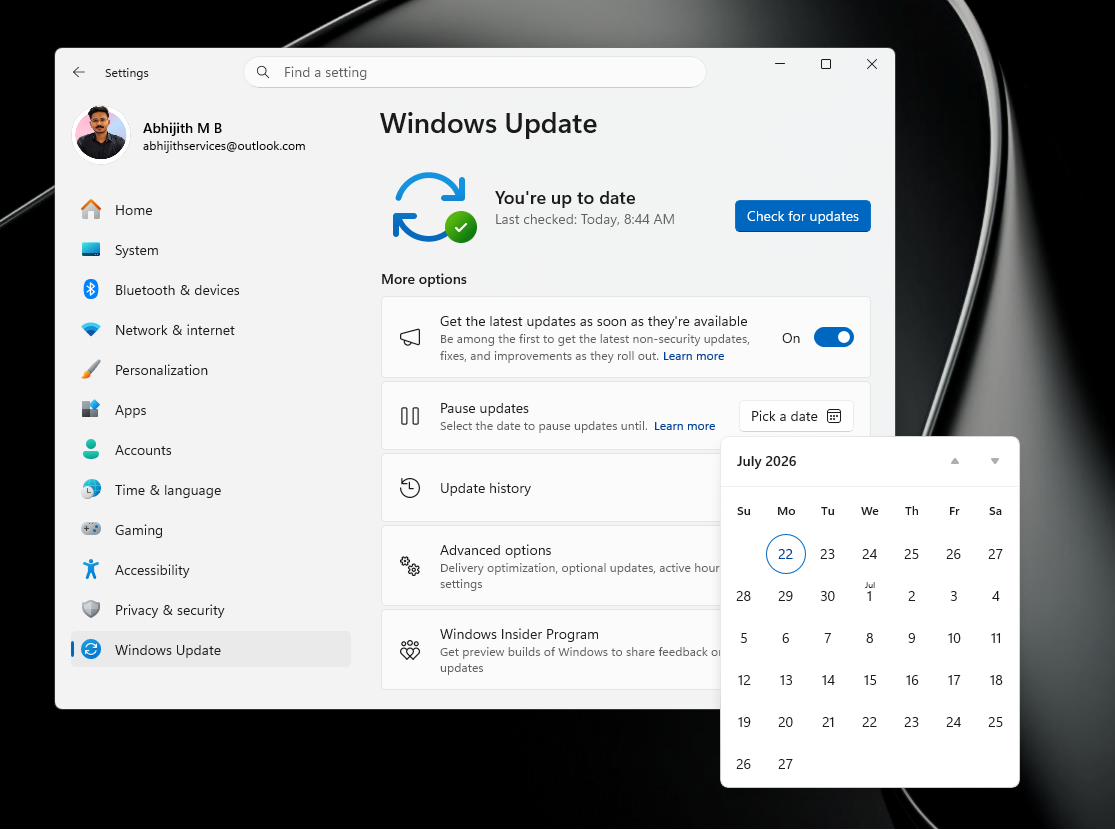
Microsoft recently added new pause controls for Windows Update, but you shouldn’t use them to block these important security fixes, or you risk exposing your personal data to attackers.
The post Microsoft warns users to install Windows 11’s latest update within 3 days, 400+ security bugs fixed appeared first on Windows Latest