
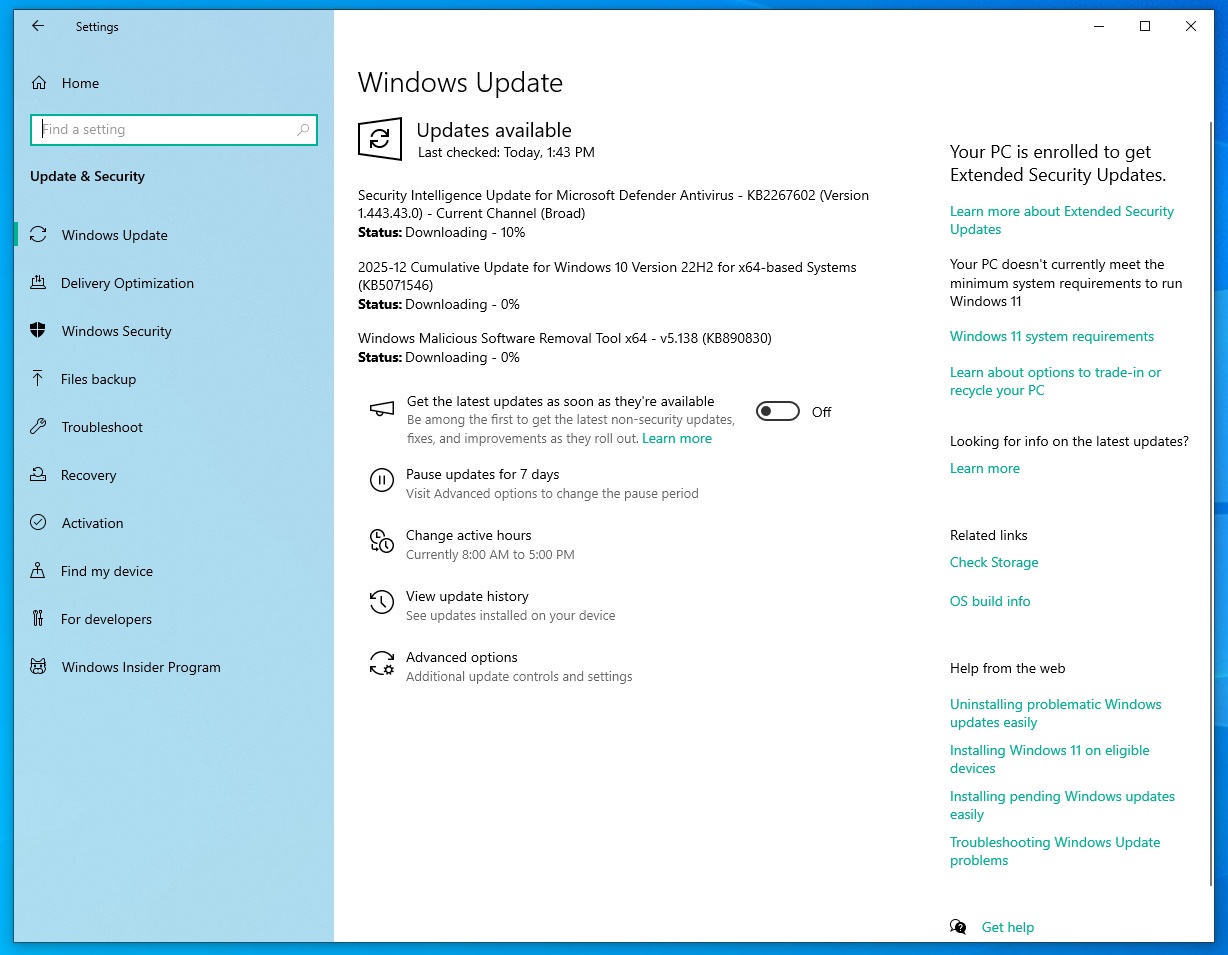
Microsoft has confirmed what we heard from our readers: December 2025’s Patch update (KB5071546) for Windows 10 has a bug that causes issues with MSMQ, otherwise known as Message Queuing (MSMQ). This issue mostly affects businesses, as consumer PCs do not have MSMQ installed or enabled, and consumer apps also don’t depend on MSMQ.
For those unaware, MSMQ (Microsoft Message Queuing) is a component that allows apps or services to send messages to a queue so another app or service can process them later.
In most cases, it is used by enterprise apps to manage background tasks, and if the MSMQ component stops working, a lot of background tasks simply stop running and block the primary app or website.
If your apps rely on Messaging Queuing (MSMQ), you might not be able to open apps or sites that rely on IIS, which stands for Internet Information Services, and is also responsible for locally hosting apps or sites. Again, as I mentioned, a casual user would not do any of this, but if you’re affected, you’ll see the following error.
System.Messaging.MessageQueueException: Insufficient resources to perform operation.
How Microsoft broke MSMQ with Windows 10 December 2025 update
Windows Latest understands that the December 2025 update (KB5071546), which is only for ESU (Extended Security Update)-enrolled PCs, likely changed how MSMQ works. This affected the component’s security behaviour. Microsoft also updated NTS permissions where MSMQ stores queue data, which, according to our tests, is the following:
C:WindowsSystem32MSMQstorage
After the patch, the account that uses MSMQ now needs write access to that storage folder. In many real setups, MSMQ is accessed by IIS app pool identities, LocalService or NetworkService, or a locked-down service account that doesn’t have write permission there.
As a result, MSMQ can’t create or write its message files, and it starts failing
One user told Windows Latest that their queues refuse to connect. You’ll also see an “inactive” state, which confirms something is odd. Unfortunately, if you restart the service or the server itself, and even try reinstalling the Messaging Queuing (MSMQ) from optional features in Control Panel, it will still not work.
However, if you manually navigate to the Windows Update history and remove Windows 10 KB5071546, MSMQ will start working again. We’re also seeing reports of the issue appearing on Windows Server 2019, but Windows Latest tests could not reproduce it on Windows Server 2022.
“I also noticed that the NTFS-Security-Descriptor gets changed from D:P to D:PAI. The AI-Flag (auto-inherited) seems that the DACLs get modified or changed. That could lead to Users like iis_iusrs / localservice /networkservice to be not allowed anymore on this folder,” one of the affected users wrote in a Microsoft forum post spotted by Windows Latest.
Another system admin who installed KB5071544 on Windows Server 2019 also experienced similar issues, including MSMQ “insufficient disk space or memory” errors,
“Correct, my IIS apps that require MSMQ to function completely stop, and my monitor records it as a 500 error,” one user explained.
Here’s what the error “Insufficient resources to perform operation” looks like when you’re affected by MSMQ issues.

Microsoft confirms MSMQ failure as a known issue in the latest update for Windows 10 or Windows Server
Microsoft has confirmed that it’s investigating issues with Message Queuing (MSMQ) after installing Windows 10 KB5071546, and it has nothing more to share.
“After installing this update, users might face issues with the Message Queuing (MSMQ) functionality. This issue also impacts clustered MSMQ environments under load,” Microsoft noted in an update to the support document spotted by Windows Latest.
This issue does not affect Windows 11, so it’s isolated to just Windows 10, which is odd because the operating system is on extended security support, and it’s barely getting any noticeable changes. It makes you wonder how Microsoft could break older features in Windows even when the OS itself is no longer being developed for new “features.”
How to fix MSMQ issues in Windows 10
If you run into problems after the updates, you will need to uninstall Windows 10 KB5071546 and pause updates while Microsoft figures out a patch.
To remove the update and fix MSMQ issues, follow these steps:
- Open Settings > Updates & Security > Windows Update > Update history.

- Click “Uninstall updates.”
- This will open the Control Panel.

- Now, select the KB noted above and click “Uninstall.” This will remove the update.
- Reboot to finish applying changes.
What about you? Do you also have issues after the December patch? We’re not seeing major problems on Windows 11 with the December 2025 update, barring a few exceptions, such as installation errors.
The post Microsoft admits Windows 10’s extended updates are causing issues, MSMQ won’t work appeared first on Windows Latest